When conducting the TransACT training courses on behalf of Omnibus, there is always a specific part of a network I once worked on that is used to explain a concept or two. This is because of the amount of lessons I personally learnt early in my career as a result of operating this one part of a greater network.
Firstly I should help you by explaining the scenario as I first encountered it. As part of a city network there was one estate, sandwiched between major trunk roads, being served by 2 circular routes. The service 5 & 5a each operated with a 30mins headway that combined to create a 15mins headway from the City to the estate.
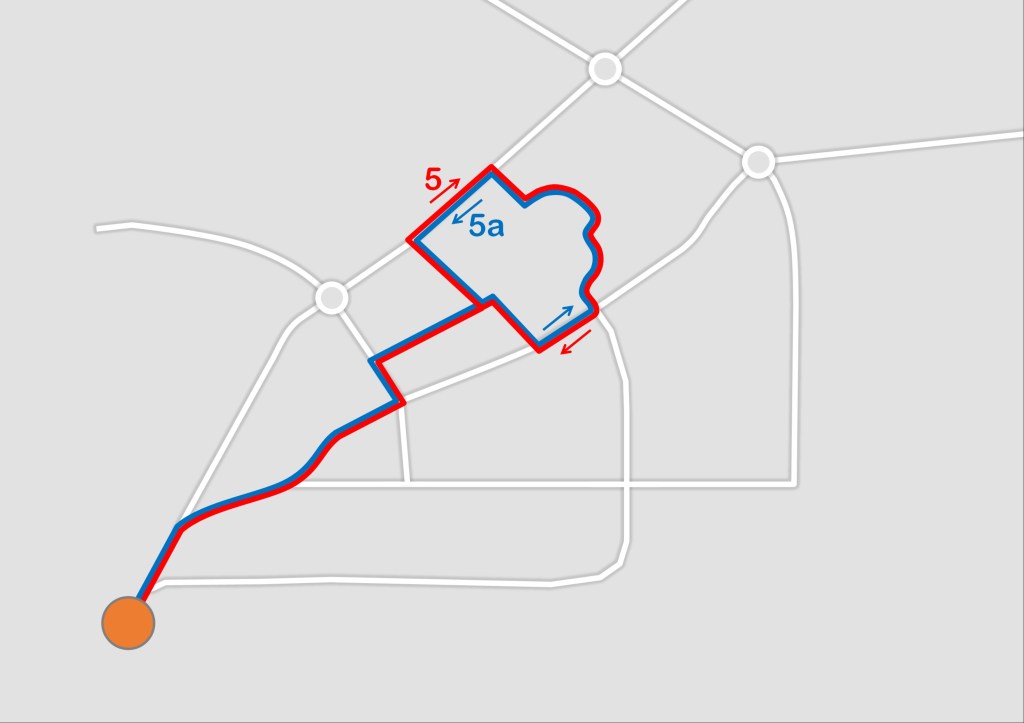
These services each had 2 vehicles allocated to them all through the day, however, with a 45mins round journey time, it should have been possible (on paper at least) to share resources and operate these using just 3 vehicles. This had been the case in the past, but due to persistent late running a 4th vehicle was added to improve reliability.
Due to a fall in revenue, it was no longer deemed sustainable to continue using 4 vehicles on these services. However, due to the problem of late running we knew operating a 15mins combined headway with 3 vehicles was not going to work either. So the easy answer would be to drop it to a 20mins combined headway.
Now this wasn’t really as straight forward as that, as a 20mins combined headway is a reduction in service. This would also lead to a 40mins headway on each route, meaning in some hours 2 journeys operate on the 5 and in others only 1; and the opposite for the 5a. Therefore the next step in the process would be to drop one service to make sure every journey operates the same way around the estate.
Again, there would be a simple answer here; just drop the 5a. All the other services on the network are the 1, 2, 3 etc. without any ‘a’ or ‘b’ variants, so keeping the 5 seems the most logical choice, right? Well, instead of the simple answer it was decided that we should investigate the performance of each service to make sure that the right route was being taken out.
Upon investigation it was found that the service 5 in most cases returned to the City centre around 5mins later than scheduled, whereas the 5a was always within a couple of minutes of its planned arrival time. This therefore suggested that the 5a was the more reliable of the 2 services and should be the route every journey should take going forward.
Interestingly, the reason for the service 5 always being late is so straight forward it was never considered an issue. Both the service 5 & 5a had the same round journey time of 45mins as they covered the same route, albeit in opposite directions. Amazingly, that was the problem. Due to the service 5 operating a CLOCKWISE loop, it had to perform mainly right turns at junctions and the more reliable 5a had mainly left turns. Unfortunately for the service 5, these right turns were being attempted on main trunk roads, across heavy oncoming traffic. Despite there being traffic lights on 4 of these turns, none of them gave any priority for vehicles turning right. Some did however allow priority for left turns which was of great benefit to the service 5a.
After looking at the performance of each route and deciding to make every journey a 5a, we could now also have the confidence that operating a 15mins headway with only 3 vehicles was possible. This was due to knowing this service had the correct round journey time of 45mins and was reliable with it. This is why we increased the headway back up to the every 15mins, as late running shouldn’t be an issue.
So this was only a small and simple change, but there are certainly lessons here to be learnt;
1) Know your networks. The issues regarding right turns and late running was common knowledge amongst the drivers, however, as the extra resource was already there to remedy this no journeys were lost and therefore hadn’t been considered higher up. Being as knowledgeable as the drivers would have been a great benefit here.
2) The easy answer isn’t always the best answer. As was seen here, operating at a 20mins headway initially seemed the easiest and best way forward. However, this forced us to look at operating only 1 route, to avoid the unfriendly 40mins headway. Has it happened, this forced change meant a better 15mins headway could be achieved instead of the ‘easy’ 20mins answer anyway.
3) Learn from your mistakes. Although it had happened before my time there, the addition of the 4th vehicle onto these routes had been the wrong decision. It was the easy answer at the time (see lesson 2!) but all it achieved in the long run was an increase in cost. The key problem persisted, although it was now masked by the inefficiency the extra resource brought with it.
So here we have 3 important lessons gifted to us thanks to one simple network review.
But it doesn’t end there, the next lesson this route can teach us is that it is sometimes necessary to break from the norm to achieve a goal.
As we know, during most of the day the new service 5a operates nicely with the 3 vehicles on a 45mins round trip time. However during the am and pm peaks the running time gets effected by traffic congestion along the route, a common problem in pretty much every town and city across the UK.
For this route we had 3 options open to us for dealing with this issue, however each had their own pros & cons;
Option 1, we could extend the running time and change the headway from every 15mins to every 20mins and keep the same 3 vehicle resource requirements.
Pro; resource maintained therefore costs are managed.
Con; the headway suffers at potentially the busiest period
Option 2, we could extend the running time and keep the headway at every 15mins by adding in a 4th vehicle.
Pro; Headway maintained (or could potentially be improved?) during the busiest period.
Con; additional resource, and therefore costs, required.
Option 3, we could keep the headway at every 15mins and the 3 vehicle resource requirements by finding a way to reduce the running time in the peaks back down to 45mins for a round trip.
Pro; Headway and resource required maintained over the busiest period.
Con; to reduce the running time it may be necessary to change the route and perhaps miss stops as a result.
To decide which of the 3 options would work best for us we should remind ourselves of certain points raised earlier. Firstly, we mentioned that the ‘Due to a fall in revenue, it was no longer deemed sustainable to continue using 4 vehicles on these services’. This comment would suggest that option 2 would not be suitable. It was also stated that a ‘20mins headway is a reduction in service’, and if we consider that we have found a way to maintain the 15mins headway during the day, we should perhaps try to preserve that where possible over the peaks. This could suggest that option 3 is the most favourable, however the impact of potentially missing some stops needs to be assessed if we do follow this path.
Looking back at the route maps there is a section of route, known as ‘Central Drive’, which is where the service first deviates away from the main trunk roads and before the loop of the estate begins. We looked at passenger figures to assess the impact of missing out this section, at certain times of day, and the data showed customers overwhelmingly using these stops towards the City in the am and from the City in the pm.
With this knowledge we could confidently argue that by missing the Central Drive stops in one direction over the am & pm peaks, we wouldn’t be causing any significant disruption for our customers. All that remained was to test whether this would reduce the running time sufficiently to maintain the headway of 15mins across the 3 vehicles allocated to the route.
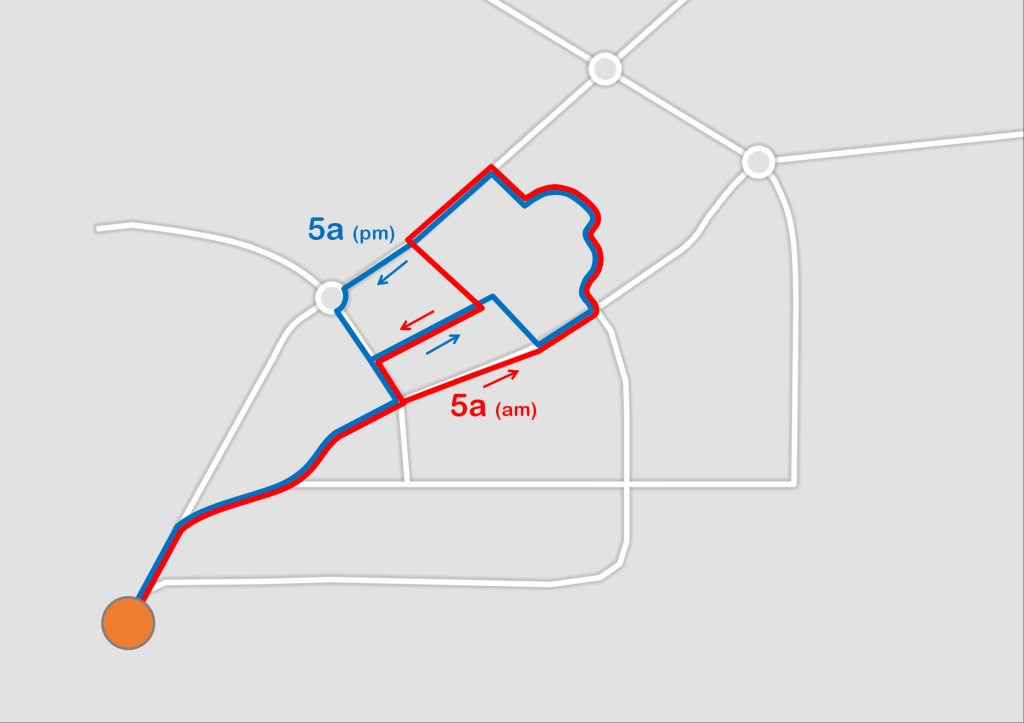
Fortunately, the position of the estate, between 2 major trunk roads, helped us no end. The greater road speeds, boosted by the fact buses were running against the main flow of traffic, meant that the time saved by missing Central Drive was enough to allow for additional runtime in the opposite direction. This meant that despite the traffic congestion at peak times, it was still possible to provide a 15mins headway and still only require the 3 vehicles to do so.
In Summary, the service 5a, although a very simple service, that required only a simple revision to maintain its profitability, provided a young bus scheduler (myself) with a host of valuable lessons as to how changes to scheduled bus services are planned. As a result, I feel it is important to use this service as an example to help pass these lessons onto other new schedulers whenever I can.
There are still more lessons this route can offer regarding things like vehicle allocations and evening variations, but perhaps we shall save these for another time.
 Written by; Kieran Proctor, Business Development Manager, Omnibus
Having started as a bus driver with Stagecoach in 2007, Kieran quickly worked his way through the company becoming a scheduler in 2009 at their East Midlands subsidiary. His time at the Lincoln head offices gave Kieran exposure to a vast range of different operating territories including city networks, rural outstations and seasonal tourist towns.
After only a couple of years in the East Midlands Kieran was seconded to a small team tasked with organising transport for the media, athletes and officials at the London 2012 Olympic and Paralympic Games. This project saw many scheduling challenges and unique pressures, all of which were successfully navigated by the team.
In 2013 Kieran joined the software provider Omnibus in a business development role. Since then he has scheduled on a consultancy basis for bus and light rail operators of various sizes across the UK, Middle East and Australasia. When Omnibus took on the running of Jim Hulme’s long established TransACT manual schedules training course in 2018, Kieran became heavily involved in the project and has already used his scheduling knowledge to help teach the next generation of schedulers. Going forwards, Kieran hopes to use this course and his experience to continue to reskill the schedulers within the UK bus industry.
 The TransACT Blog