Inter-timing services over common portion of route
Separate services often share a common portion of route before they proceed to different termini. It is desirable, where possible, that two or more services that operate in this way should provide an even headway over the common section. For example, if two separate services each operated to a 20 minute headway, it would make sense if they combined to provide a 10 minute headway over the common stretch of route. This exercise will look at the mechanics of providing what is known as inter-timing separate services.
Look at the following route network:
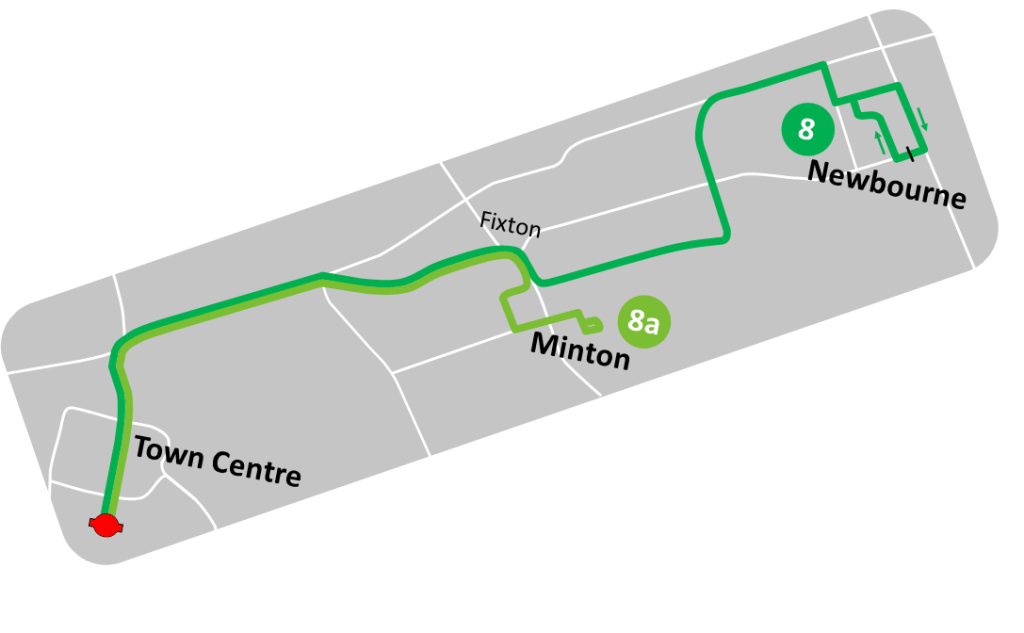
Service No. 8 operates between Town Centre and Newborne via Fixton
Service No. 8a operates between Town Centre and Minton via Fixton
| Running Time | 26 minutes each way (service 8) |
| 13 minutes each way (service 8a) | |
| Town Centre to Fixton 10 minutes each way | |
| Layover | 2 minutes minimum at each terminal point |
| Headway | 12 minutes on each service |
The frequency over the common portion of route is a sum of the frequency (buses per hour) of the two separate services;
5 + 5 = 10
The headway over the common portion of route that gives exact inter-timing is:
60 minutes / frequency = headway
60 / 10 = 6 minutes
Services 8 and 8A should be timed, therefore, to provide a common headway of 6 minutes between Town Centre and Fixton.
Calculate the number of buses required
Service No. 8
26 + 2 + 26 + 2 / 12 = 56 / 12 = 5 buses + 4 minutes
Service No. 8A
13 + 2 + 13 + 2 / 12 = 36 / 12 = 3 buses + 6 minutes
Test to see if interworking will save a bus
Here is a reminder of the test that will decide if interworking will or will not save a bus:
- if the total excess layover on two or more independently operated services is equal to or greater than the service headways, a bus can be saved by interworking
- headways must be compatible
- there must be at least one common terminal point
The total excess layover time is 10 minutes whilst the headway of the two services is 12. A bus cannot be saved by interworking.
 The TransACT Blog